
Is electric the ideal choice for tender power?
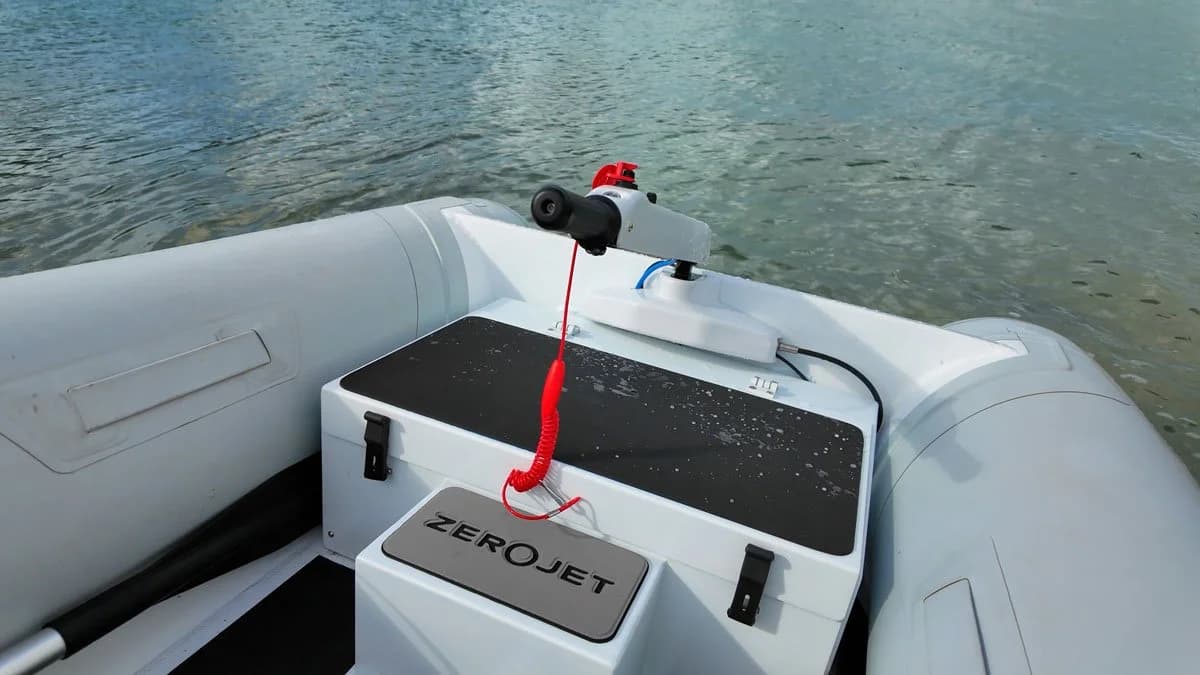
Can an Electric Tender Plane With Four Aboard? Yes
Some tenders have one job: get a person and a bag of groceries from the mooring to the dock and back. Then there's the other kind — the one that carries four or five adults, a cooler, and the dog across a wide channel, and has to get on plane doing it. That used to be the strongest argument for keeping a gas outboard on the tender. It's now a job an electric motor does, and does well.
There are two systems we sell that are specifically suited for this job and are worth a closer look. The Momentum M10 is a 10 kW outboard that puts a loaded tender on plane, whether it's a RIB or a hard-bottom dinghy. ZeroJet is an electric jet drive built into the hull that can run at 20 to 24 knots with no outboard on the transom. It needs a hull built around it, so it comes on tenders from ZeroJet's hull partners — OC Tenders, Highfield, and AB Inflatables all build boats to fit the system. Here's why electric is the better choice for a tender, what each system does, and the real numbers for speed and run time.
Why go electric on a tender? Torque, quiet, and no gas aboard
A loaded tender asks three things of its motor: enough power to get a full boat on plane, a ride the crew can talk over, and as little as possible to fuel, fix, or carry. Electric answers all three. An electric motor delivers full torque from the first turn, so a full boat climbs onto plane without the bog-down of a small gas outboard. At speed, the loudest thing aboard is the hull on the water — the person in the bow can talk to the person at the tiller at 15 knots, and nobody in the stern is sitting in exhaust.
Then there's what you stop carrying and doing. No jerry can of gasoline on the mothership for a tender that burns through it fast. No engine oil, no fuel filters, no carburetor to clean out when stale fuel gums it up, and no raw-water pump on the M10 or scheduled servicing on a ZeroJet for the first three years. Charging happens overnight — at the dock pedestal, the yacht's inverter, or a wall outlet at home — while you sleep, for cents per kilowatt-hour instead of marina fuel by the gallon.
Which electric motors plane a tender? Anything from 10 kW up
Whether a tender planes comes down to power. Below about 10 kW, electric outboards such as the ePropulsion Spirit 2.0 and Navy 3.0 move a dinghy at displacement speed, and for short, slow trips to the dock that's all a tender needs. From 10 kW up, a tender with four or five aboard gets on plane — the Momentum M10, Stealth Electric Outboards, and ZeroJet's 15 and 20 kW drives all live on that side of the line. Two of them are worth a close look.
What is the Momentum M10? A 10 kW outboard that planes a tender
The Momentum M10 is a 10 kW, 72-volt outboard that Momentum rates as a 20 hp replacement, with 140 lbs of thrust. The motor and prop weigh approximately 48 lbs; the mount is approximately 13 lbs and stays on the transom, so the motor itself lifts off with a quick release and connects with a single cable that carries both power and data. Cooling is passive seawater over the sealed motor and controller — no water pump, no impeller, no flushing after a salt run.
It runs on Momentum's 6.4 kWh MB-6 battery (5.5 kWh usable), which weighs 81.4 lbs and lives in the boat, with the trip computer showing live range on a color display. Momentum's published figures with one MB-6:
Speed | Run time | Distance |
|---|---|---|
16.2 knots (on plane) | 0.8 hours | 12 nm |
11.9 knots | 1.3 hours | 15 nm |
5.6 knots | 4.6 hours | 25 nm |
3.2 knots | 17.5 hours | 55 nm |
In Momentum's own testing on a small RIB, one battery gave 80 minutes on plane. The system takes up to four MB-6 batteries if you want more, and a full recharge on the standard 110 V charger takes about 8 hours. Momentum backs it with a 2-year warranty for non-commercial use. You can also use third party batteries like 72v Epoch’s.
What is a ZeroJet? A jet drive that planes with no propeller
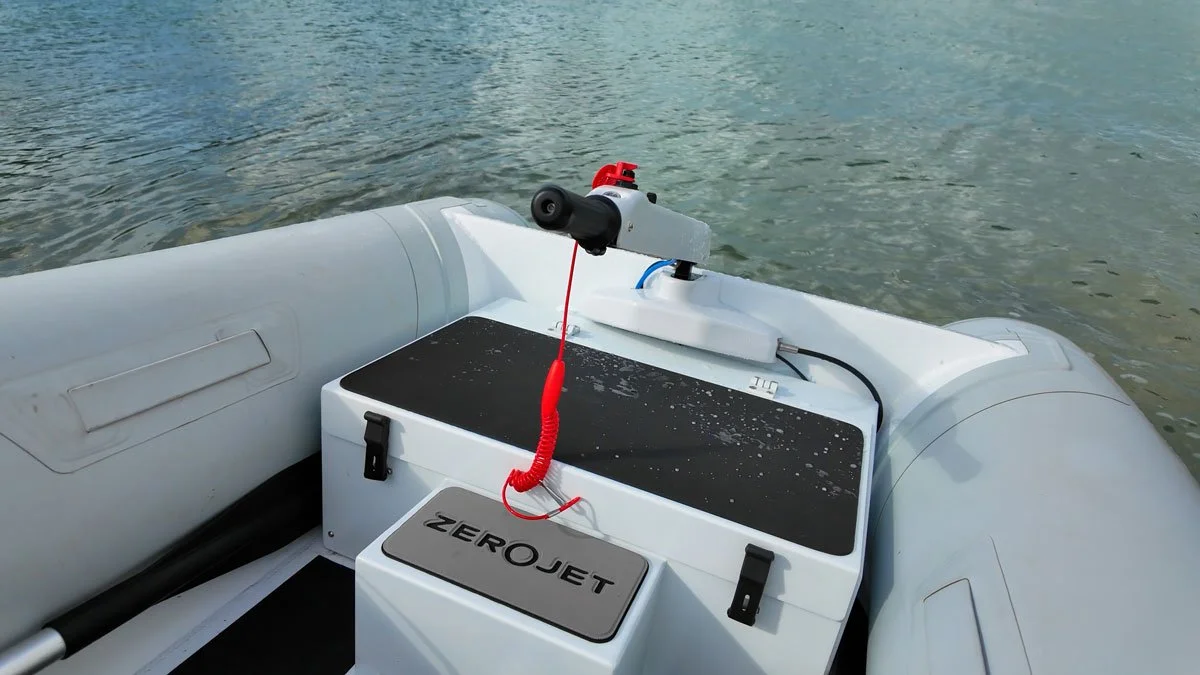
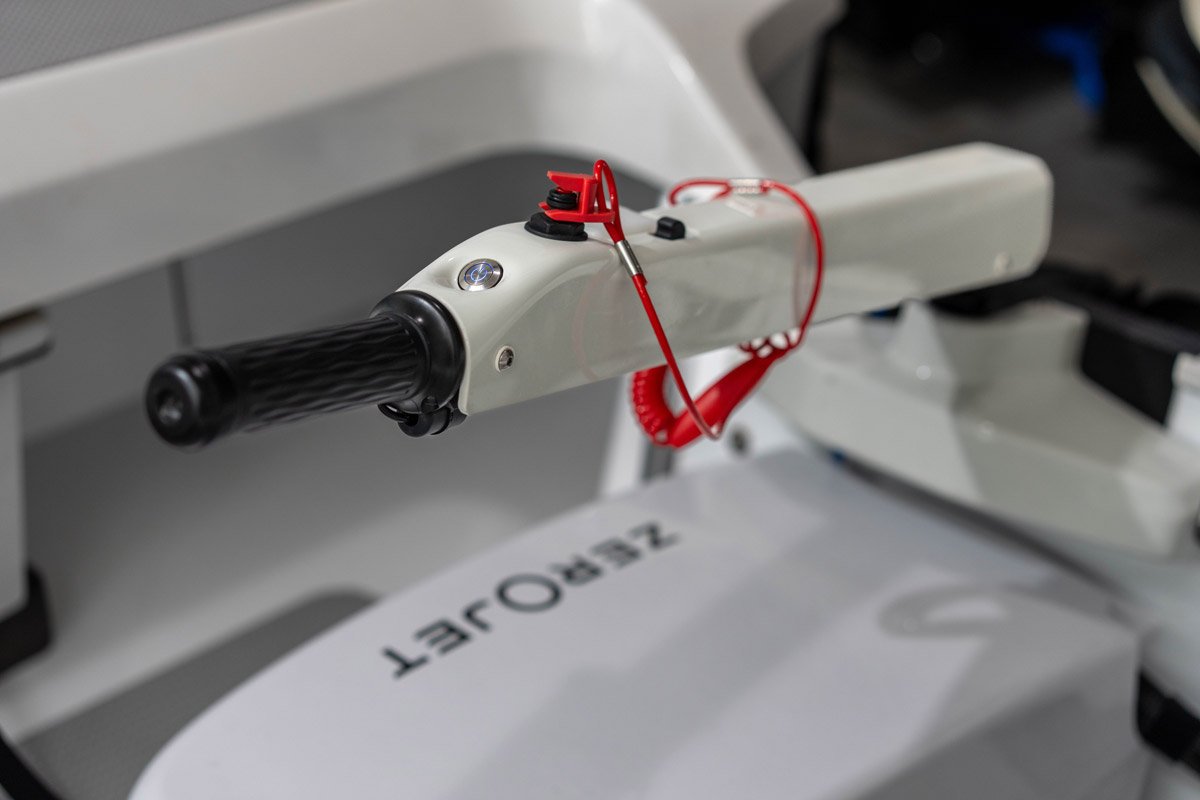
ZeroJet is a 48-volt electric jet system built into the hull at the factory, and it planes: 20 knots in the OC Tenders hulls, 24 knots in the larger MC-ZERO tenders. The motor and jet pump are one sealed unit in the deck, and the boat is steered by the jet nozzle, so there is no propeller, no gearcase, and nothing hanging off the transom. For a tender that carries kids and swimmers, that changes how you use it — people climb in over the side with nothing spinning below them, you nose straight onto a beach, and you idle through water too shallow for a prop. On the OC Tenders hull, the boat even tips on its side to let a swimmer climb back aboard.
The entry point is the OC Tenders OCT 300 and OCT 350 with the 15 kW ZeroJet drive, rated as a 20 hp equivalent. The 300 seats up to 4 with a 694 lb load limit; the 350 seats up to 5 and carries 859 lbs. Both top out at 20 knots, run 8 nm at 15 knots or 26 nm at 3 knots on the 5.4 kWh battery, and recharge in about 3.5 hours.
For a bigger crew, ZeroJet's 30 kW drive runs on a 16 kWh pack and reaches 24 knots, and the twin-jet MC-ZERO 450 pairs two of them with 32 kWh — ZeroJet's published figure is 13 nm at 17 knots with 8 people aboard. The batteries are 2.7 kWh semi-solid-state LiFePO4 modules, and the system carries a 3-year warranty with no required servicing in that period, plus 5 years on the batteries.
Check it out in our walkthrough below.
Can an electric tender plane with 4 aboard? Yes, with 10 kW or more
Getting a loaded tender on plane is a power problem. The hull has to climb over its own bow wave with four people sitting aft, and once it's up, holding plane takes far less than getting there. The two systems above clear that bar with room to spare — the Momentum M10 planes a tender at 16 knots, the 15 kW ZeroJet runs the OC Tenders hulls at 20 knots, and the 30 kW ZeroJet drives reach 24.
The sizing floor for a 10 to 12 ft tender with four adults is around 10 kW, which is where the Momentum M10 sits. ZeroJet starts at 15 kW in the 10 to 11.5 ft OC Tenders hulls and goes to 30 kW, or twin 30 kW, in larger tenders. Which route fits depends on your boat — an outboard clamps onto the transom you already have, while a jet is built into the hull at the factory.
See the Momentum M10 in action in our video below.
How long does an electric tender run on plane? 30 to 80 minutes per battery
Planing is where the energy goes, so this is the number to plan around. Here are the manufacturers' figures side by side:
Momentum M10 | ZeroJet 15 kW (OCT 300/350) | ZeroJet 2 × 30 kW (MC-ZERO 450) | |
|---|---|---|---|
Power | 10 kW, 72 V (20 hp equiv.) | 15 kW, 48 V (20 hp equiv.) | 60 kW, 48 V (approx. 80 hp equiv.) |
Battery | 6.4 kWh, up to 4 packs | 5.4 kWh | 32 kWh |
Seating | Your boat's rating | 4 or 5 | 8 to 9 |
Top speed | 16.2 knots | 20 knots | 24 knots |
On plane | 12 nm at 16 knots, 0.8 hr (one pack) | 8 nm at 15 knots, 0.5 hr | 13 nm at 17 knots, 8 aboard |
Recharge | About 8 hr | 3.5 hr w/ fast charger | Not published |
Read those as a few runs across the bay and back per charge, with the slow trips in between costing almost nothing — the M10 goes 25 nm at 5.6 knots on the same pack that gives 12 nm on plane. If your days involve more time at speed, the M10 takes a second, third, or fourth battery, and the larger ZeroJet packages scale the battery with the hull.
Ready for a sea trial? We're in Virginia Beach
A tender carrying four or more people can get on plane on electric, and it does it with full torque from the first turn. The Momentum M10 puts 10 kW on the transom you already have, with the motor lifting off in seconds and 12 nm on plane per 6.4 kWh pack. ZeroJet builds the drive into the hull with no propeller, from the 15 kW OC Tenders at 20 knots to twin 30 kW tenders at 24. In both cases, your ride is silent, the maintenance list is short, and charging happens for cents per kilowatt-hour.
If you want to experience it for yourself, schedule a sea trial.
Ready to Experience Electric Boating?
Browse our full inventory of electric boats, motors, and batteries or get in touch with our team.